Owners
Start with your own data, the half that needs nothing from your tenants.
Most conversations about landlord data get stuck on what the tenant will or will not hand over. That argument covers about a third of what you need. The other two thirds were never the operator's to give, and that data is usually the part sitting in your own spreadsheets and documents.

44%
of the care homes that closed in the year to June 2023 were rated Good or Outstanding when they closed.
478 homes, 15,234 beds. Average age thirty one years. Only 11% had wet rooms. Being well run did not save them, because the thing that finished them was never on the inspection report. Carterwood, 25 July 2023, and still the most recent published study of its kind.
Your portfolio holds three kinds of information, and your tenant controls only one of them.
Owners we talk to are usually happy to start on their own information, once they see how much of it there is. The reason the subject feels like a negotiation with the operator is that all three kinds get discussed as one thing. Pulled apart, only the middle one involves them at all, and even that one is already written into your leases.
Nobody has to send you this
What you already hold
No tenant involvement of any kind. Nothing to ask for, nothing to agree, nothing to wait for. This is the largest of the three and the one that sits in spreadsheets.
- Every lease and its mechanics: review basis and dates, information covenants, insurance and repairing obligations, breaks, renewals, guarantors
- The debt against them, the maturity wall, hedging and the cost of it
- Valuations, and the movement against the last one
- Reinstatement cost assessments and how old they are
- Building fabric, condition grades and lifecycle plans
- Capital requests, dilapidations, development appraisals and drawdowns
Most of the value, and all of it already yours
Your lease already requires it
What is owed to you
This is the only one your tenant touches, and you are not asking them for a favour. The lease already says they must send it. The problem was never access. It is that the returns arrive in fifteen shapes, late, unverified and impossible to compare.
- What was owed each quarter, what arrived, and when
- Read as sent, whatever the format, with every figure traced to the page it came from
- Each care home measured against its own filing habit, so a late return is flagged against its own history
- Rent cover by asset rather than by operator grouping
Nothing changes at the tenant's end
When a lease converts
What becomes yours
If a lease becomes an operating structure the reporting obligation moves from the tenant to you, and the first monthly pack has to exist on day one. It is built from the two groups beside it.
- Workforce, agency hours against budget
- Admissions from enquiry through to conversion, with payer mix
- Budgeting, reforecast and variance
- Benchmarking against the local market rather than your own average
What if, this morning, every statutory certificate across the whole portfolio was already listed, with the ones expiring inside thirty days flagged, and the rest updating themselves as each new one came back?
Count the certificate types on a single care home and you get a dozen or more: gas, electrical installation, fire risk assessment, legionella, lifts, hoists, emergency lighting, fire alarm, PAT, asbestos, water hygiene. Count the dated obligations that come off them in a year and a single building carries forty or more. A portfolio of thirty one care homes is therefore carrying well over a thousand live deadlines, and that is before the contractors: twenty contractors each carrying their own insurance and DBS checks add hundreds more. A dozen types a building is an estimate, and a modest one. It is the first thing we switch on, because the arithmetic is obvious.
Try it here
So how many dated obligations are you carrying?
Not a trick question, and not a hard one. It is multiplication, and almost nobody can answer it, because the answer is spread across a dozen inboxes and a filing cabinet. Set the slider to the size of your own portfolio.
It is the first thing most owners switch on, because the arithmetic is obvious before anyone has agreed anything. Either the register is complete or it is not, and you find out in the first week.
The question underneath all of it
When a care home underperforms, is it the operator or the building?
Every landlord's first answer is the operator. Before you reach for it, look at what you would actually be asking them to change. The great majority of what a care home spends goes on staff, and you cannot ask for less of that without the inspection rating following it down. Rent is the next line and it is yours, fixed, going up. What is left after those two, food, utilities, routine repairs, is small and already tight, and squeezing it gives you a worse care home rather than a better one.
Which leaves the building, and the building is yours. Room mix, wet rooms, layout, condition and the works programme set both what the care home can charge and what it costs to run. Those are the levers that are actually free to move, and you hold them. That is why this question is worth answering properly rather than by instinct: once you can see which side the problem sits on, you can do something about it, and you can help your operator do something about it, instead of replacing a tenant who will meet exactly the same ceiling.
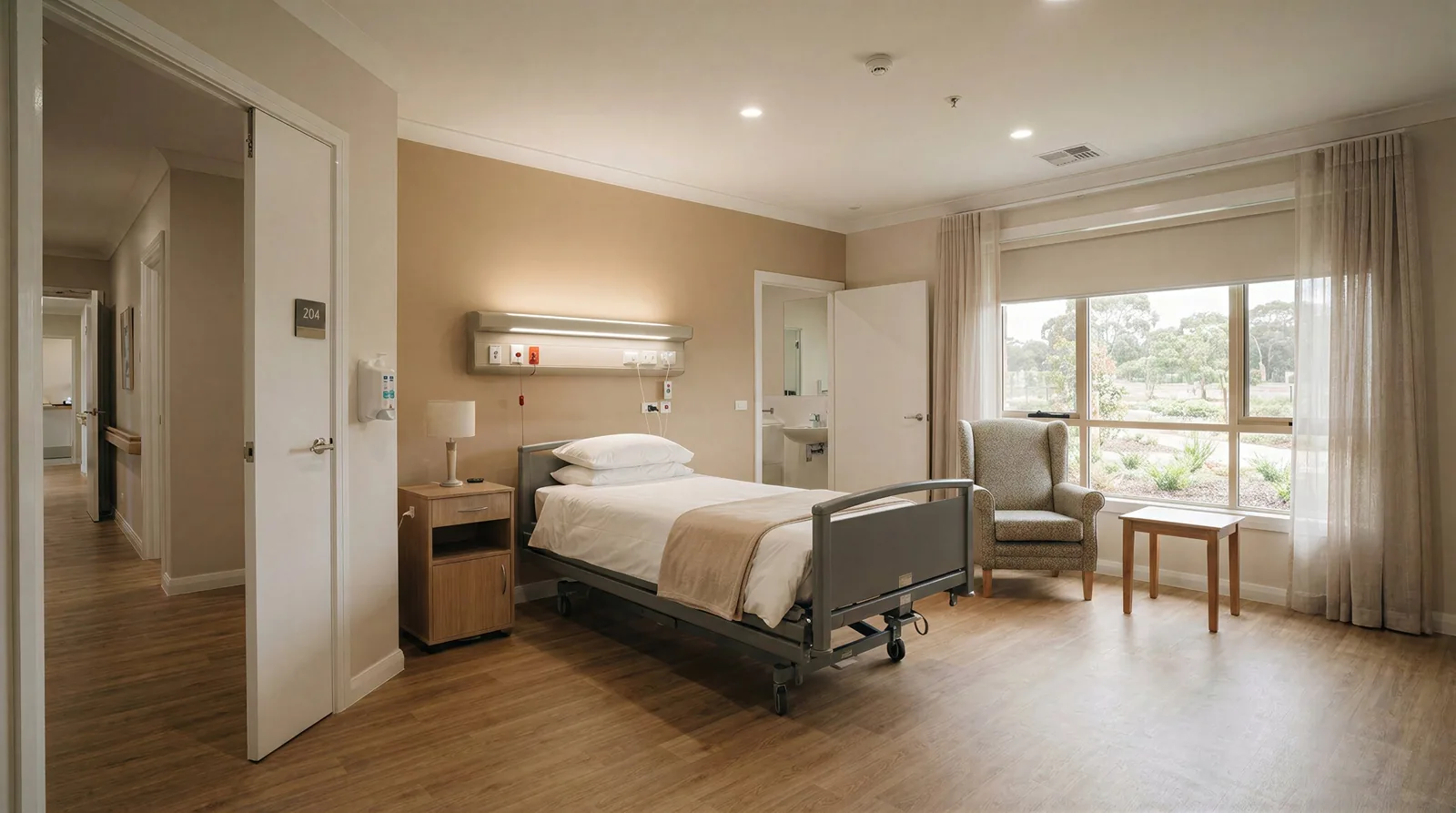
The operator decides how well the building is run. The building decides how well the whole business can possibly run.
Room mix, en suite and wet room provision cap which local fee band a care home can sell into. Across 9,165 GB care homes, Carterwood put those with 90% or more wet room provision at 16% above the rest on quoted nursing fees and 27% above on personal care. A fee gap that size is structural, not managerial, and a new operator meets the same ceiling. Carterwood, 2024 Self-funded fee and trading performance review, 17 September 2024. Quoted fees across about 96% of the market, and Carterwood states it as correlation rather than cause.
Rooms out of use for a refurbishment, a failed lift, compartmentation work or damp read as an occupancy failure and are a fabric failure. A plan with long corridors or several small wings needs more staff presence points to give the same supervision as a compact plan, where one station covers more rooms. That is a design question rather than a rota question.
And the building answers to a regulator of its own. Fire safety sits with the fire and rescue authority rather than with CQC, and in the year to March 2025 fire services audited 6,461 care homes in England and judged 43% of them unsatisfactory, serving 192 enforcement notices. That is a separate enforcement regime, running alongside the rating everyone watches, on an asset the owner holds and the operator is contracted to look after.
The reverse case is the one owners miss. Where a lease requires a fixed annual spend on the fabric and the operator has not made it, the care home trades well while your residual value is quietly converted into their current earnings.
Try it here
And what would your insurance policy actually pay out?
Your tenant insures, and the certificate is in the file, and none of that tells you whether the sum insured still resembles what the building would cost to rebuild. Pull the slider to whatever your last assessment set.
Insurance is the easiest thing on this list to put right. It needs no building work, no new system and nobody else's agreement. It needs one afternoon, the policy schedule and the last reinstatement assessment.
Five questions about your own estate.
None of these require a tenant to cooperate. They are about what you already hold and whether you can reach it.
Here is what answers them.
Nothing here is sent anywhere. It is for you to read back.
What you would be looking at
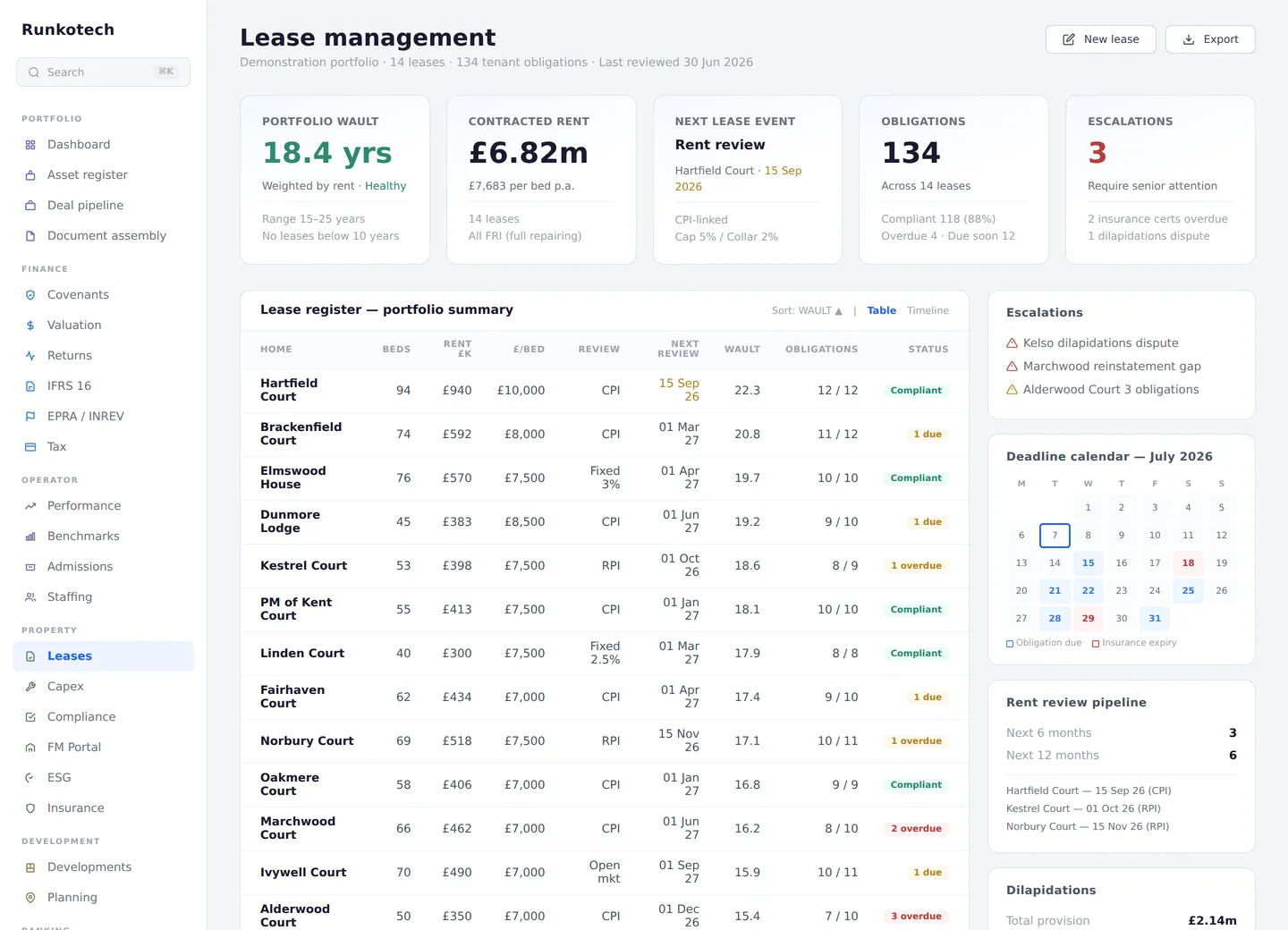
What your estate looks like before a single tenant sends you anything.
Every asset against its own covenant, sorted by how close it is.
Rent cover by care home rather than by operator grouping, with the distance to a formal breach rather than a traffic light. Where a lease carries a floor on the annual uplift, rent rises whether or not the care home trades, so cover compresses quietly. This is the page that makes that visible before the test date does.
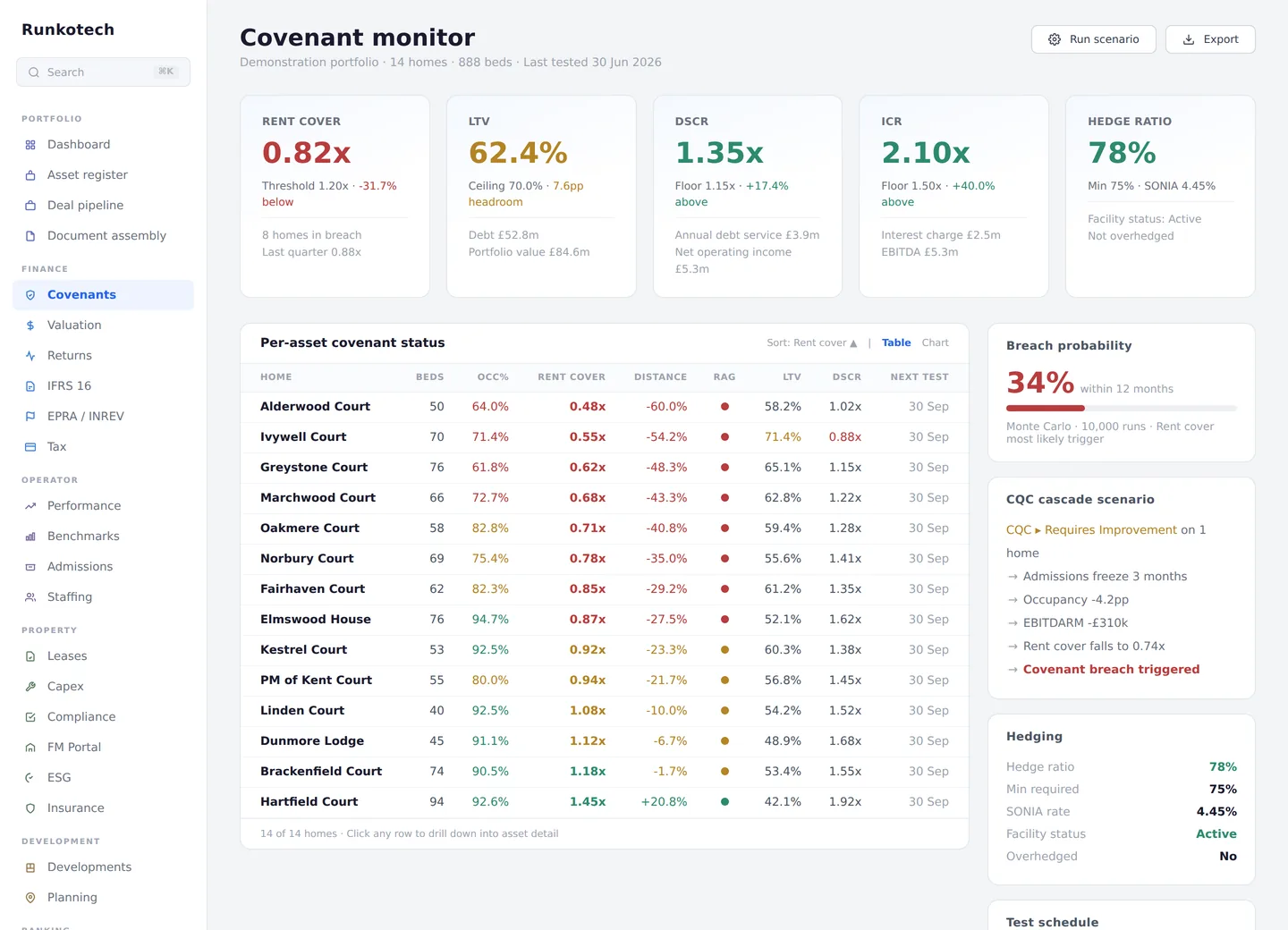
What arrived, in whatever shape it arrived in.
Returns are read as sent. For a document, the page image is shown with the words a figure was taken from marked on it, so a disputed number is settled by looking rather than by email. And each care home is measured against its own filing habit, so you chase the ones that are late for them rather than late against a generic calendar.

Five sites or more?
Start with one module, or one part of the platform, set up around your own reporting cycle rather than a demonstration. Yours, not ours.