Operators
You are responsible for the operations and the property. You can only see one.
Your clinical system holds the resident and does that well. The rest of the business is spread across head office spreadsheets and the home manager's inbox: the repairs, the refurbishment programme, the rooms out of use because of the building, the certificates and the contractors, and whether the rent is still covered.

What do you already produce
Weekly
The KPIs and the P&L sent from the care home to head office
New software at the care home
None
Nothing changes for the manager
Training required
None
Copy the email you already send to head office to the platform, and carry on
Runs alongside
Yes
It runs alongside your existing work in head office
What is actually on your mind
We think your week runs roughly in this order.
Not the order a software company would put them in. The order they actually interrupt you in.
First, who is on shift
Agency is the biggest controllable cost in the building and the one that hurts every morning. Covering a night shift at nearly twice your own rate is a decision somebody makes at seven in the evening, and you see the consequence at the month end, on a management account.
Then, who is coming in
Enquiries, assessments, admissions and the ones that went elsewhere. Occupancy is the number everybody reports, but it is referrals and conversion that move it, and they move slowly enough that by the time the percentage falls the cause is three months old.
Then the rating
An inspection is existential and public, and it affects referrals, insurance, lenders and staff recruitment all at once. It is also the one thing on this list where the building can sink you for something no one on your team did wrong.
Then the money
Fee negotiations, the local authority uplift, what the bank will say at the next test, and whether the rent is still covered. By the time this reaches the agenda the levers that would have moved it were pulled, or not pulled, months ago.
The building sits underneath all four and almost never appears on the list. Room mix decides which fee band you can sell into. Layout decides how many staff it takes to supervise a floor. Condition decides how many rooms you can let at all, and a lapsed certificate or a failed lift takes beds out of use without anyone calling it an occupancy problem. You can pull three levers very hard while the fourth quietly caps all of them, and nothing you own today will tell you that is happening.
Five questions.
How many can you answer before lunch today?
Not whether the answer exists somewhere. Whether you can put it in front of a lender, a landlord, an insurance broker or a board by the end of the morning.
Here is what answers them.
Nothing here is sent anywhere. It is for you to read back.
Try it here
How many empty beds before the bank calls?
Hartfield Court is the strongest care home in this portfolio: 94 beds, 92.6% occupied, rated Outstanding, rent covered 1.45 times. Two covenants, measured against two different things, break at two different points, and neither of them waits for the quarter.
EBITDARM is struck before rent. Take the rent out and £540,000 is what this care home actually earns, so five empty beds takes two thirds of it while the margin everyone watches barely moves.
What you would be looking at in the software platform
The operating week, and the properties underneath it.
Monday morning, before anyone arrives in the office.
Occupancy against target with the empty beds priced, so 78.8% against a target of 87% reads as 207 empty beds and £14.4m of income not earned, rather than as a percentage. EBITDA before and after head office. Rent cover against the covenant, and how many care homes are already below the threshold it sets. Cash across every account, daily, with what has not reconciled. And the things the platform raised on its own, because a care home three months under threshold does not announce itself.
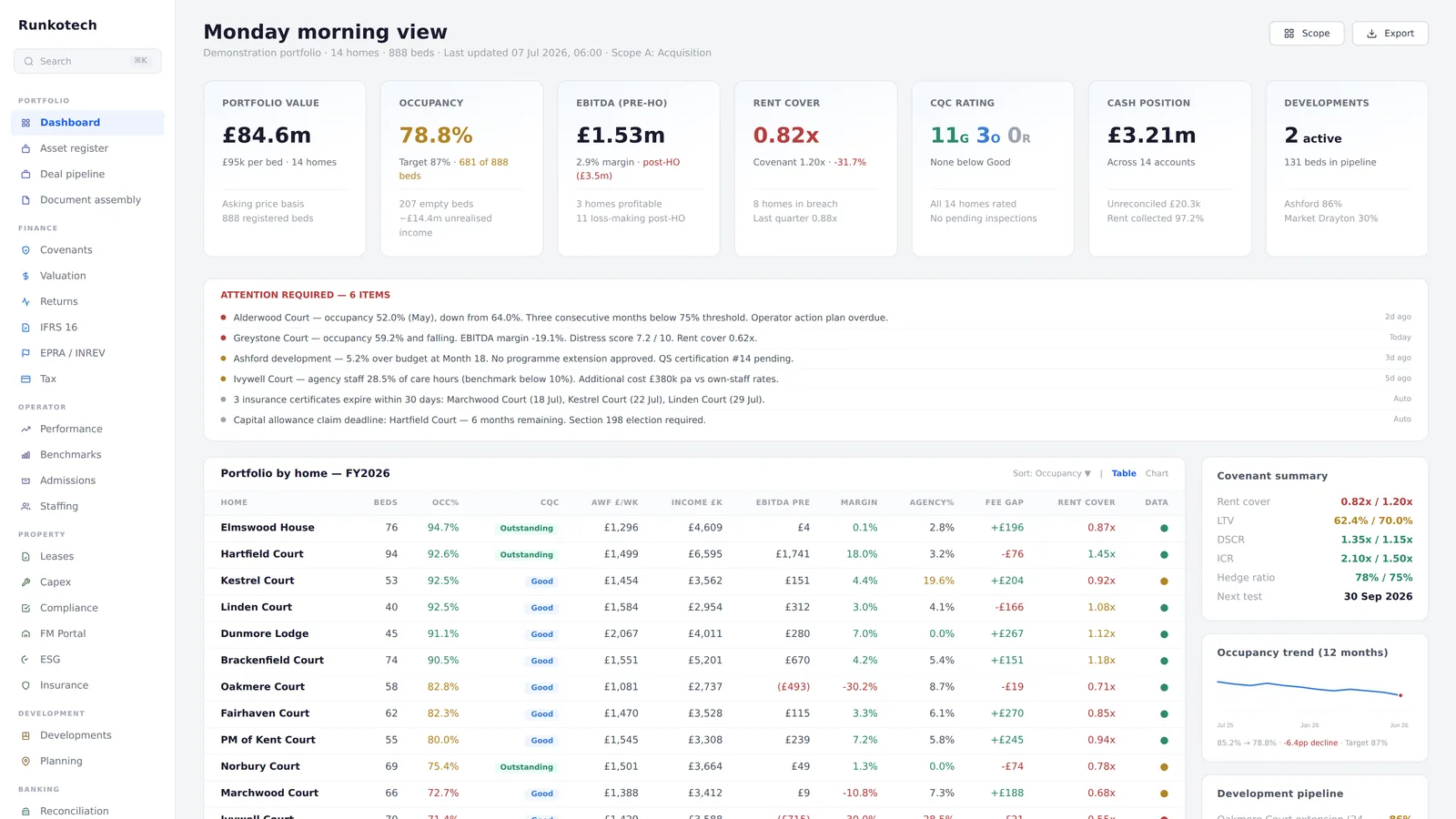
Clinical software is a quarter of it. Operations and property are the other three quarters.
Statutory certificates by care home and date. Work, contractors and their paperwork. Planned work, reactive work and refurbishment, joined to the capital plan and to the rooms each one takes out of use. On a full repairing and insuring lease every one of those obligations is yours for twenty five or thirty years, and none of them appear in a care record.
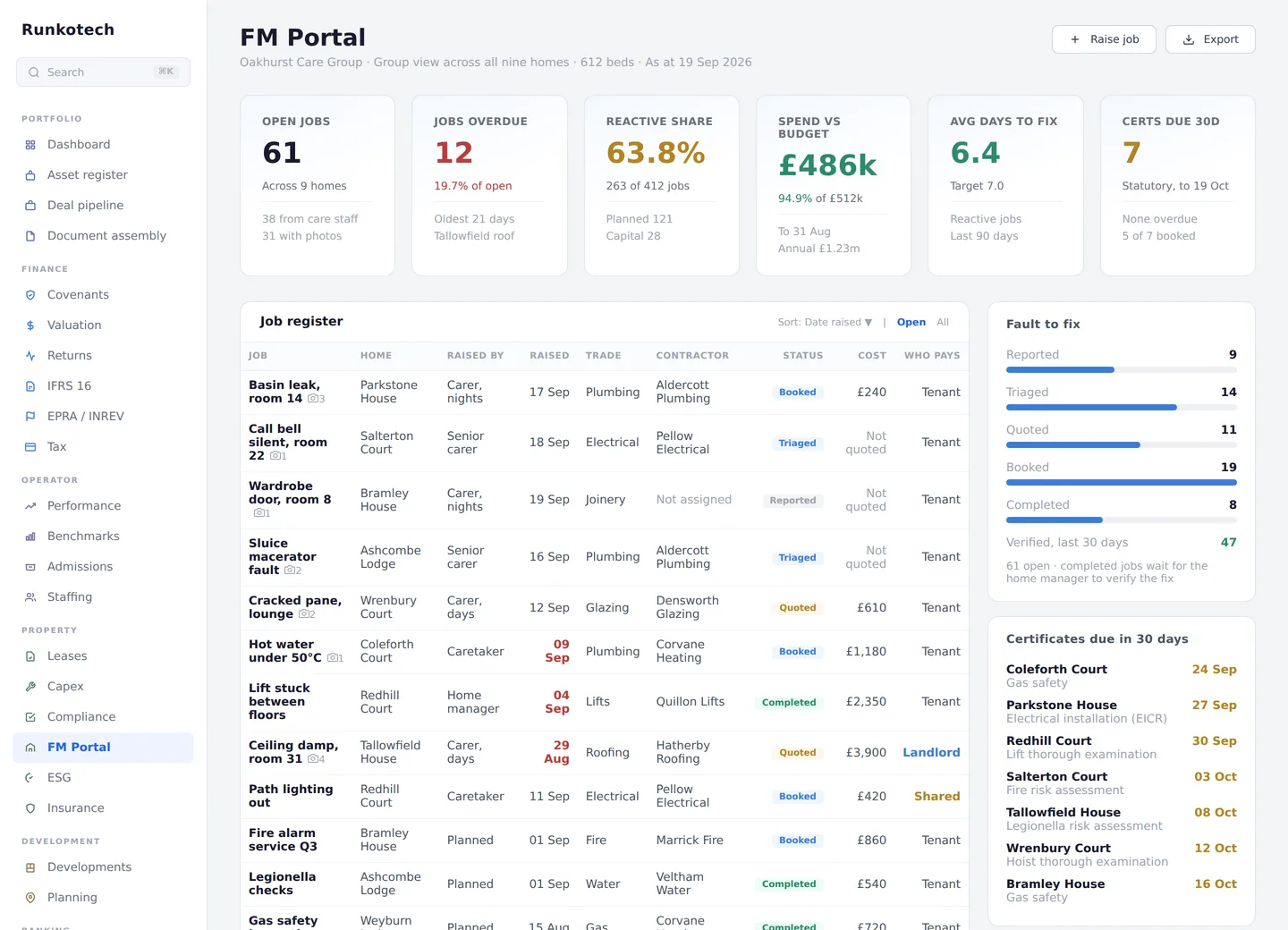
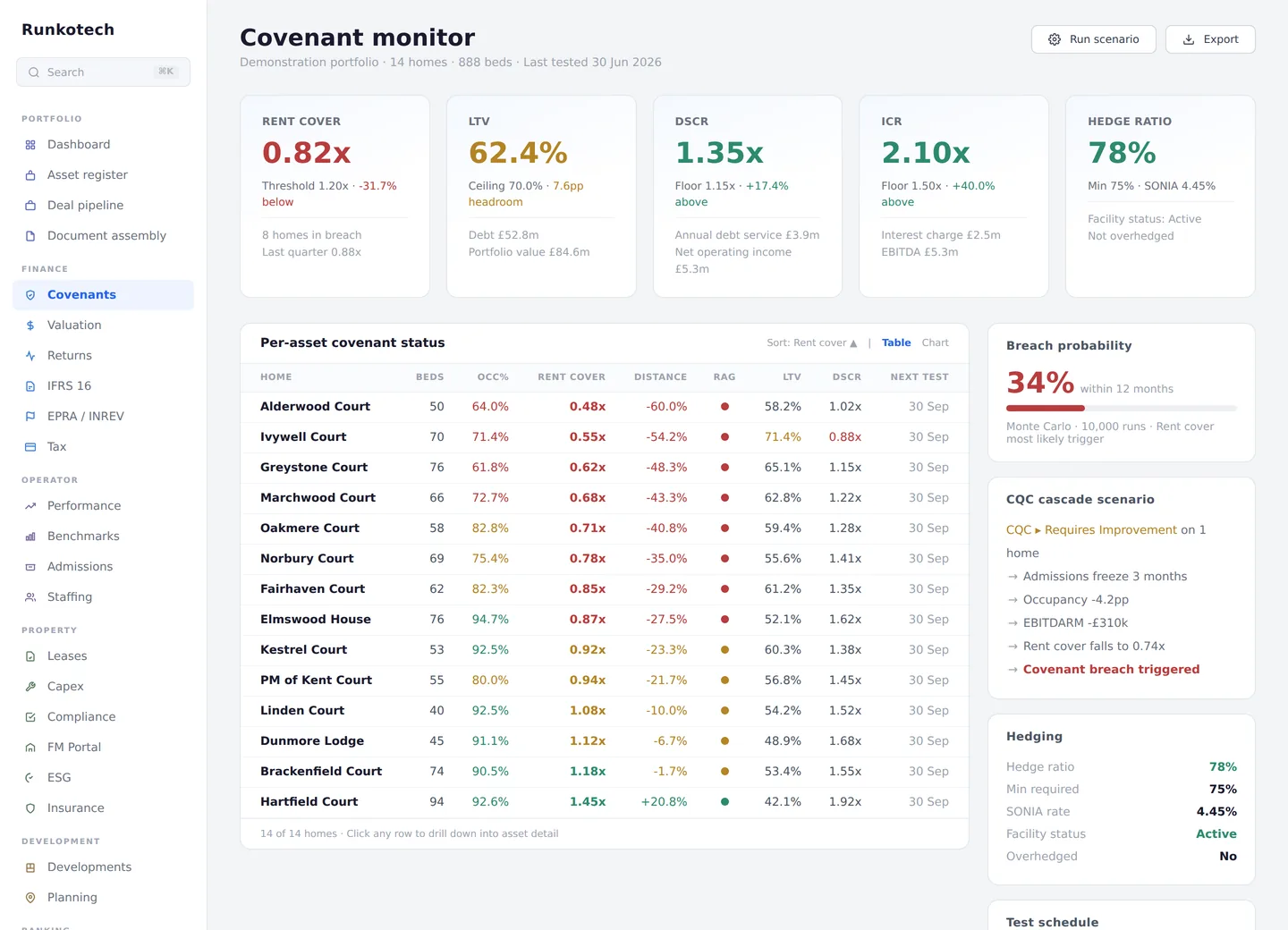
And the covenant, tested against the clause rather than a spreadsheet.
Rent cover, loan to value, debt service cover, interest cover and hedging, each against the threshold that actually set it. Automatically re-struck whenever trading moves, rather than at the quarter, so the first time you hear about headroom is not from your lender.
What arrived, in whatever shape it arrived in.
Your care homes do not all send the same thing in the same way, and asking them to is how a reporting project dies in its first month. Returns are read as sent. For a document, the page image is shown with the words a figure was taken from marked on it, so a disputed number is settled by looking rather than by email. Every figure keeps the file, the page, the sender and the date it came from.

Go deeper
A walkthrough, on whichever modules matter to you.
Someone takes you through the modules you actually care about, on the demonstration portfolio, and you ask whatever you like while the screen is in front of you. Usually half an hour, and we come with questions, because we have worked on the operator’s side of these structures.
- Whichever of the thirty-eight modules are of interest to you
- How a change moves through the record, shown live
- What we ask of you to get started, and what it costs
- Security, hosting and the certification timetable