RIDEA/SHOP/ManCo
You carry both the operation and the property. Most software holds one.
Under a lease, half the hard questions belong to somebody else. Under RIDEA, a SHOP portfolio or a management agreement they all land on the same desk on the same morning: the occupancy and the agency bill, and the rent cover, the valuation and the loan. This page is the operator page and the owner page joined together, because that is what the structure does to you.

Leased and operated, in one portfolio.
Nothing here asks you to run two systems while part of the estate is still let. A full repairing and insuring asset and an operated asset sit in the same register, with rent cover where it is let and EBITDARM where it is run, valued on one basis rather than two sets of workings that have to be reconciled by hand before every board.
Both sides also have a page of their own, and most of what is on this one is drawn from them: the operator view for the trading, the owner view for the leases, the debt and the fabric. They are not three products. They are three ways into the same platform, reading the same record.
Six questions, and all six are yours.
How many can you answer before lunch today?
Three of these an operator is asked. Three of them a landlord is asked. In this structure nobody is standing between you and any of them, which keeps catching groups out, because the two halves are still assembled by different people and joined by a third.
Here is what answers them.
Nothing here is sent anywhere. It is for you to read back.
Who builds the monthly information pack, and what do they build it from?
Most of those figures you already hold. The gap is narrower than it looks.
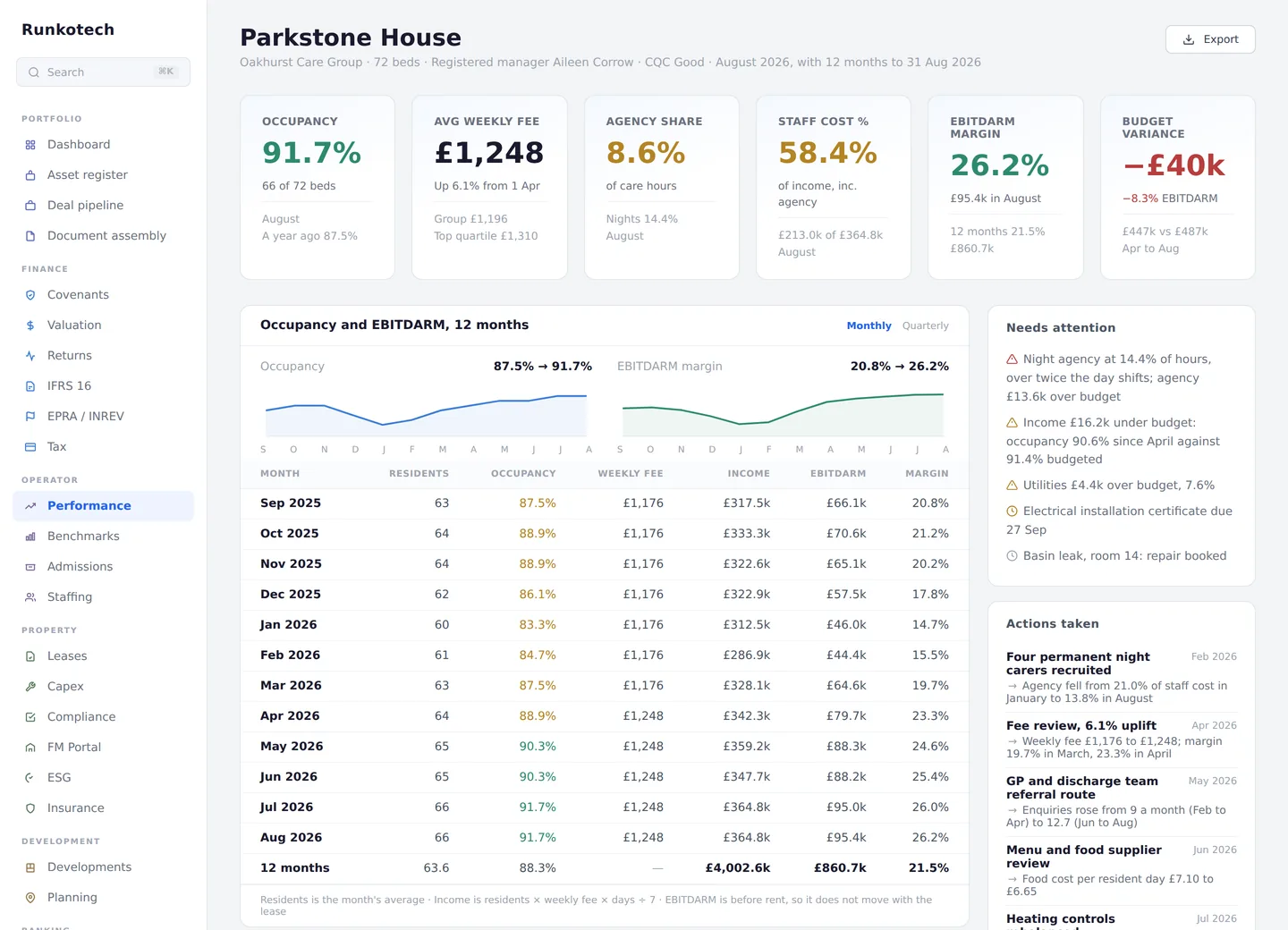
The property half of an operating pack is the half you have owned all along: the asset, the lease history, the condition and capital position, the debt, the valuation. What SHOP adds is depth on the trading side, and that is the half most owners have never had to hold themselves. It is the half the platform reads straight out of the documents and returns you already receive.
Forward funded or financed developments.
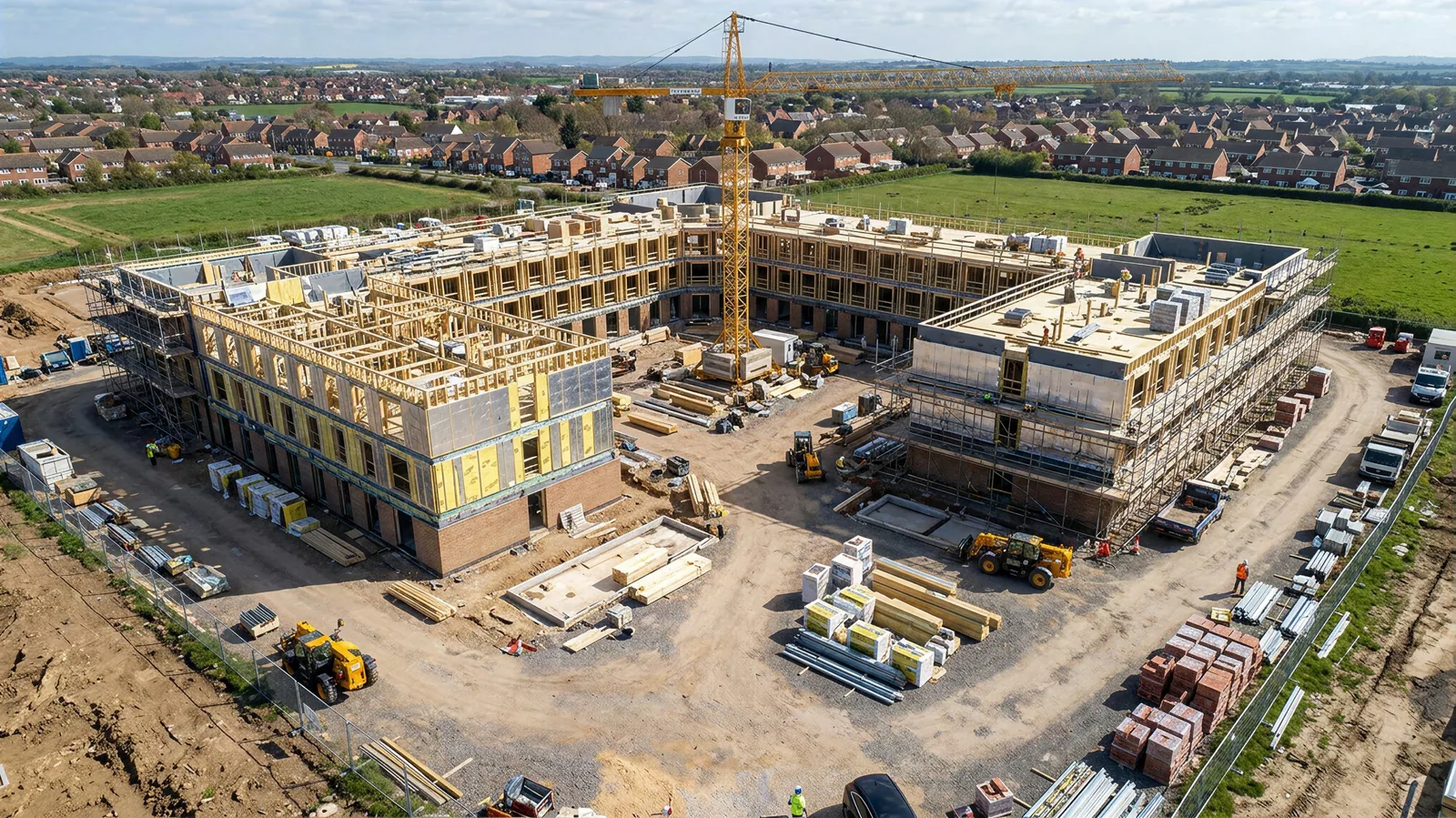
A forward funded scheme is bought before it exists: you commit to the price, the developer builds, and it arrives as an operating asset rather than as a let investment. A financed scheme is the other shape, where you carry the build and the debt against it, and the cost to complete is yours. The appraisal is the baseline either way, and against it sit programme milestones, cost to complete tested against current build costs, variations against contingency, retention, and the interim valuation certificates with the overdue one named.
At practical completion the building stops being a project and becomes an asset with obligations. The certificates, warranties, the operation and maintenance information and the defects period all start on that date, and they open the compliance register for that property rather than being filed somewhere and remembered later. Lease up against the fill rate the appraisal assumed begins the day the care home opens.
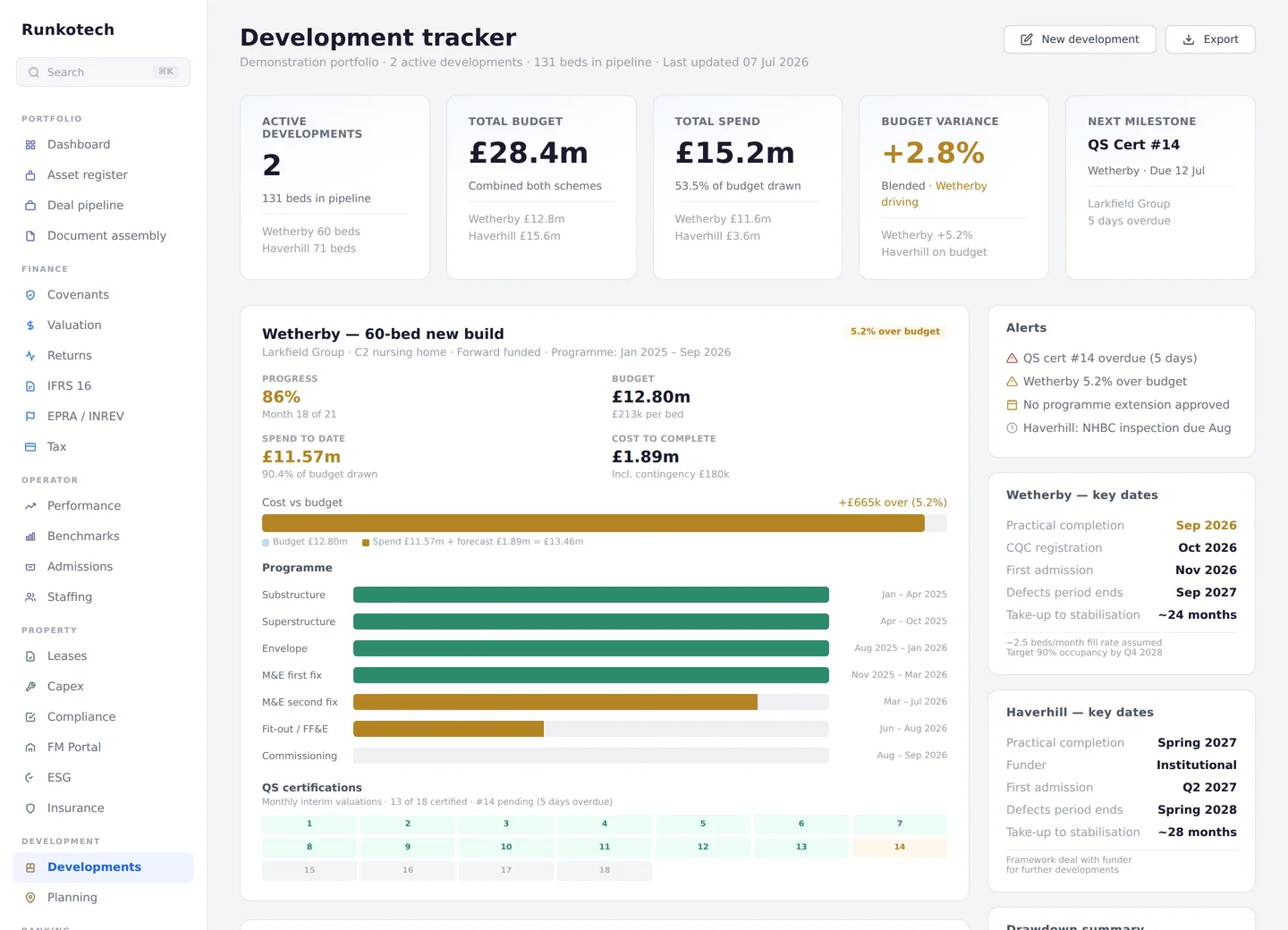
The value was fixed before anyone broke ground
Try it here
How much overrun before the scheme stops making money?
Less than anyone expects. The value was fixed by the trade and the yield before anyone broke ground, and the debt is sized on that value rather than on the cost, so the overrun has nowhere to go but equity.
A forward funded scheme arrives as an operating asset rather than as a lease. If it arrives having quietly eaten a third more equity than the appraisal asked for, that is the number the first board pack has to carry.
And when a management company runs it for you.
Most owners who move to a SHOP structure do not intend to run the operation themselves. A management company runs it, for a fee, and in the accounts that fee is simply another line of head office cost sitting above the care home. Economically you are close to the position where the OpCo and the PropCo are the same party, which is the thing RIDEA and SHOP were written to allow in the first place.
The cost moves. The risk does not.
A ManCo is paid a fee and carries very little. Occupancy, agency, fee rate, the inspection rating and the trading result all sit with the structure, or with the family office that owns both sides of it. If the care home has a bad year, the ManCo has a normal one.
So the reporting has to be yours
You are the one carrying the result, which means the monthly pack cannot simply be whatever your ManCo chooses to send. You need the same figures they are working from, on the same timetable, with the documents they came from still attached, so you can check a number rather than ask for it.
The management company works in the software platform too
Your management company is not sending you a monthly report out of its own systems. It works in this platform, on the same pages an operator would use: the Monday morning view, performance by care home, the maintenance portal, the compliance register. Nobody is assembling a pack for you at month end. They are doing the work in it, and you are looking at the same screen while they do.
One version of the business, however many parties
Owner, management company, asset manager and lender end up arguing about whose number is right far more often than about what to do. Here there is one figure, with the file, the page, the sender and the date still attached to it. Everybody is looking at the same business, and the conversation moves on to the decision.
If you are getting there from a lease
Changing from a lease to SHOP.
When a lease becomes an operating structure the reporting obligation moves from your tenant to you, and on the first day of the first month the pack has to exist. The pages that will carry it are the pages carrying your lease pack today. They are not replaced at the change, and there is nothing for you to set up. They simply begin to fill from the other side.
Reporting regime
Lease accounting is labelled for the standard that applies to the reporting entity, not to the country the building sits in. A portfolio with a United States parent and United Kingdom assets reports under both, and the platform does not assume which one you are.
United Kingdom and Europe
IFRS 16
Right of use assets and lease liabilities, with the discount rate held per lease
United States
ASC 842
Operating and finance classification carried separately
Both
One register
The lease is entered once and reported under the regime that applies
Investor reporting
Your basis
Funds from operations or net tangible assets, whichever your market reads
What arrived, in whatever shape it arrived in.
A management company sends what a management company sends, and a tenant under a lease sends something different again. Neither has to change. Returns are read as sent. For a document, the page image is shown with the words a figure was taken from marked on it, so a disputed number is settled by looking rather than by email. Every figure keeps the file, the page, the sender and the date it came from.

Five sites or more?
Start with one module, or one part of the platform, set up around your own reporting cycle rather than a demonstration. Yours, not ours.