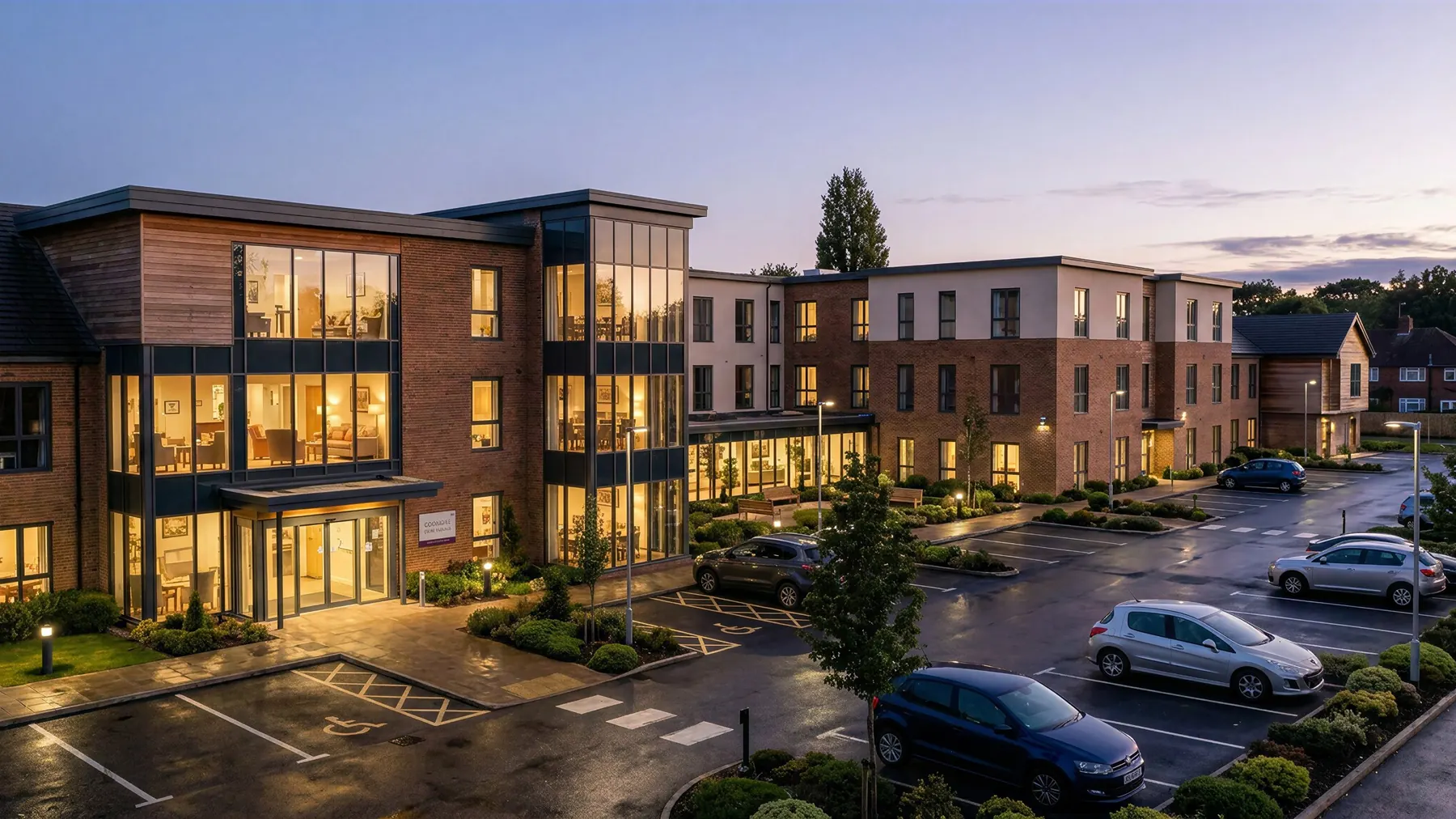
One platform for the operation and the property. Use one module on its own, or run the whole platform.
Runko is software for the people who own and run care homes. It reads the reports, invoices and certificates your homes already email out, and turns them into one live view of the care business and the building it runs in. Your homes carry on sending what they already send, with no new system to learn.
Built for the United Kingdom, the United States and Europe
One software platform, and three places to start.
Start from wherever you sit. You run the care homes, you own the property, or you hold both sides at once in a RIDEA, SHOP or ManCo structure. It is the same record underneath, read from your end of it.
You run them
Operators
You already hold the clinical operations, and you hold them well. What you do not hold in the same place is the operation around them and the property underneath them, and the lease has committed you to all three.
- Rent cover daily, not at the end of the quarter
- Voids priced, not counted
- Certificates, contractors and insurance in one register
- Every obligation the lease puts on you, with its date
- What the building is doing to the margin, for each care home
- The inspection rating beside the figures that move it
See the operator view ›
You own the properties
Owners and landlords
Start with the half that needs nothing from your tenants at all. The leases, the debt, the valuations, the fabric, the insurance, the acquisition pipeline, the developments, and the asset and fund management on top of them. It is usually the half that sits in spreadsheets.
- Lease covenants: rent and costs owed against what arrived, daily
- Insurance and reinstatement sums, and when each was last assessed
- Condition of the building, lifecycle maintenance and what the lease requires
- Every certificate across every property, by date and by who holds it
- Rent cover and loan to value by asset
- Valuation on the basis your lender actually tests
- Lease accounting under IFRS 16, from the clauses rather than retyped
- Acquisition pipeline and developments, against the appraisal
- Asset management and fund reporting on one basis: registers, rent roll, WAULT and the distribution waterfall
See the owner view ›
You own both the operator and the property
RIDEA, SHOP and ManCo
When you hold the property and the trading, the reporting obligation is yours on both sides. Whether you run the operation yourself or a management company runs it for you, the figures have to arrive in one place, on one timetable, and be the same figures.
- Leased, owned and operated properties in one portfolio
- What the ManCo sends you, with the source sitting behind it
- Daily and weekly data arriving on its own, built from what already exists
- The same figures on both sides of the structure
- Rent cover where it is let, EBITDARM where it is run
- One valuation basis across the whole portfolio
- Certificates and insurance across every property, with their dates
- Capital spend and facilities management, planned against committed
See how it works ›
You do not have to take the whole platform.
Fifteen of the thirty-eight modules run on their own, and it makes no difference which of the three above you are. Whether you operate the care homes, own the property, or hold both sides at once, you can take one module against your own data without the rest of it. Most groups switch on one, then a second once the first has earned it, and nothing is migrated when the second arrives because both were always on the same record.
What the software platform is for
Across a portfolio of care homes, most of these questions take days to answer. Every one of them should take a click.
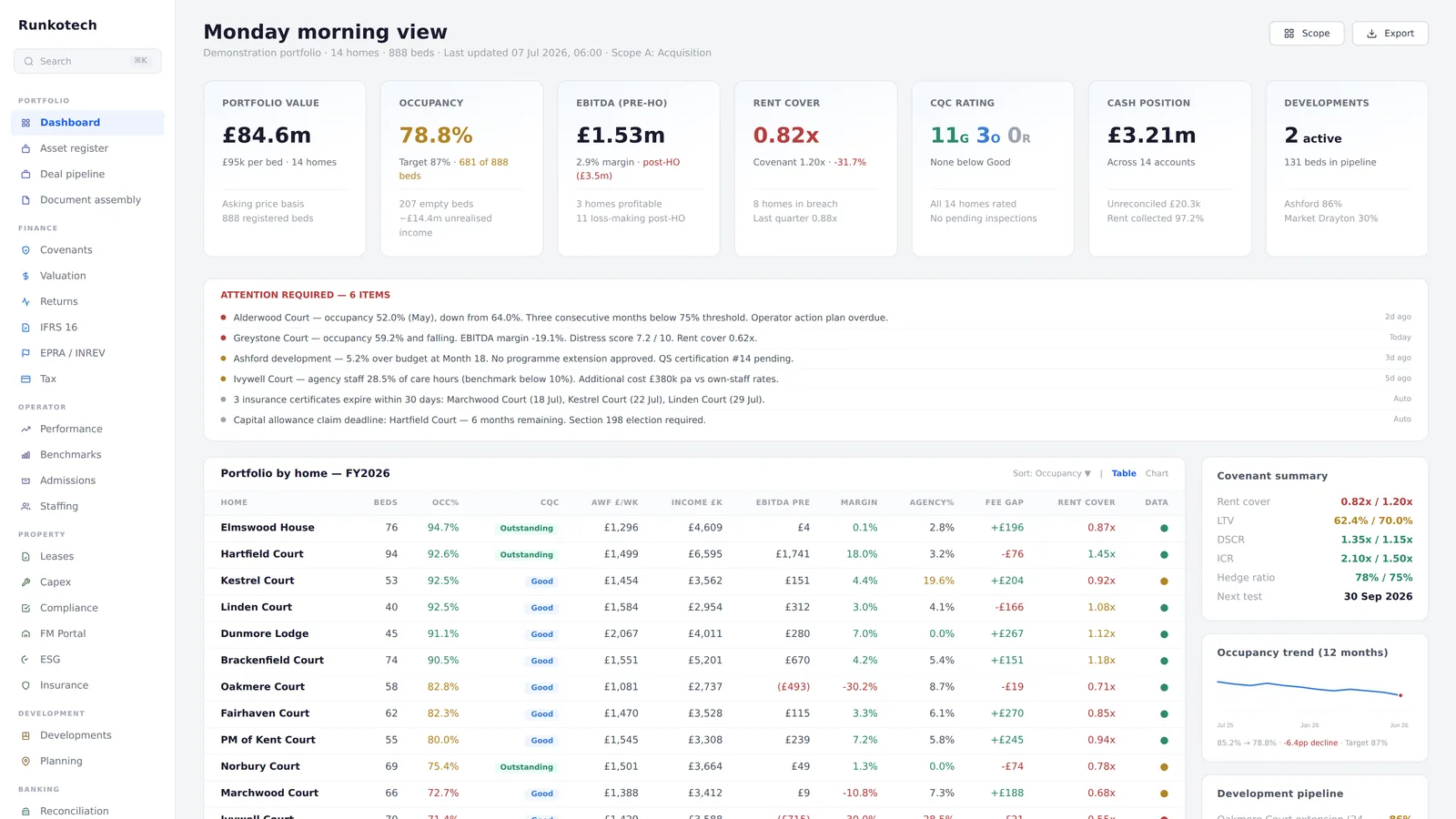
Half past seven on a Monday morning, before anyone arrives at the office. The whole portfolio is already on one screen, and three things on it are worth looking at.
Which rooms are out of use today, and what is each one costing you a week?
An empty room after someone has just moved out is not a line in next month's occupancy percentage. It has to be turned round quickly, and that takes the clean, the repair, the certificate and the next admission all moving together down the same chain. Price the room by the week against whatever is holding it and you can decide whether to accelerate the works. Count it at month end and the decision has already been taken for you.
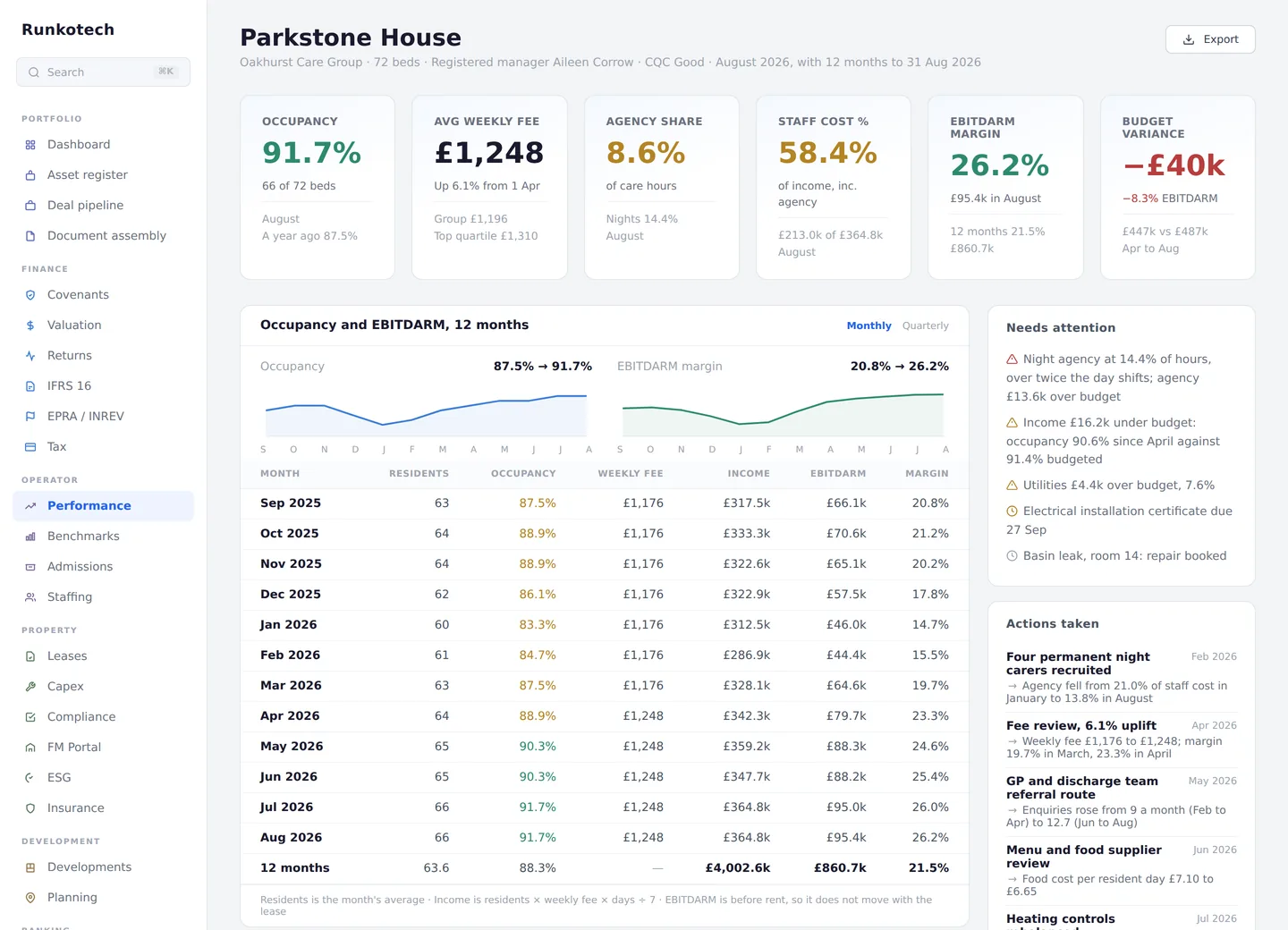
When a care home misses budget, is it fees, occupancy, agency or the building?
Four causes, four owners, four different fixes. Fees belong to pricing and the local market. Occupancy belongs to admissions and enquiry conversion. Agency belongs to rostering and recruitment. The building belongs to capital, and it is not something the care home manager can fix. It also sets the ceiling on the other three: the room mix decides which fee band you can sell into, the layout decides how many staff it takes to run a shift, and the condition decides how many rooms you can let at all. Miss that and you are pulling three levers while the fourth quietly caps all of them. Until the trading sits beside the fabric, all four arrive as a single margin figure, and the conversation defaults to the operator, because the operator is the only side anyone can see.
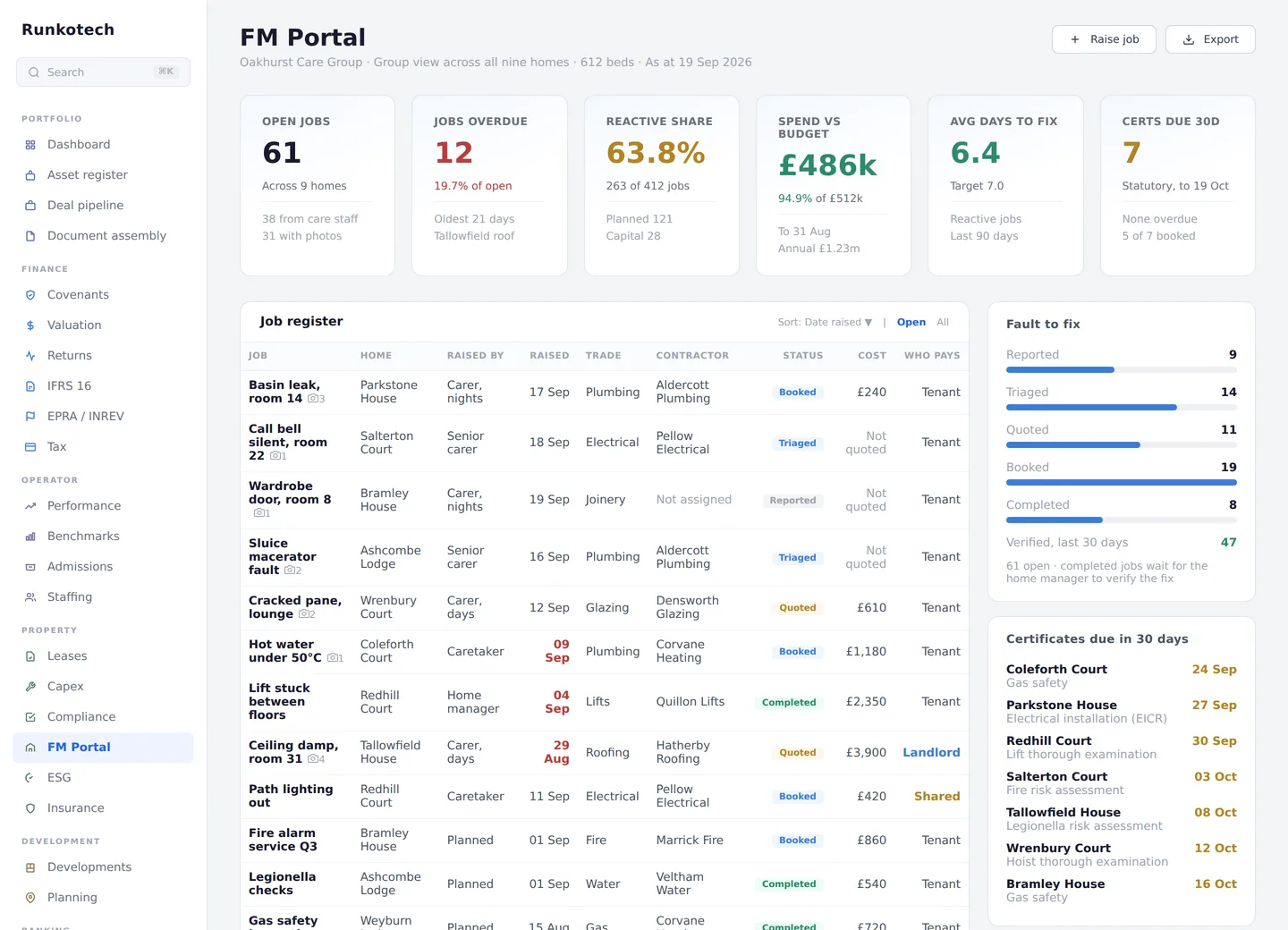
Which contractor is in your care homes right now, and is their insurance and DBS checked?
The certificate sits in a folder at head office, the booking was made by telephone, and the care home has no way of knowing either. If something happens, the insurer asks for both documents, dated. In Runko a job cannot be issued to a contractor whose insurance or DBS has lapsed.
Try it
Pick the question that is actually your problem, and see what answering it looks like.
Four places people start. Pull the slider and watch what moves, because in this asset class nothing moves on its own.
How much of your profit did the last five empty beds take?
Two thirds of it, once the rent is paid. Hartfield Court is the strongest care home in the portfolio: 94 beds, 92.6% occupied, rated Outstanding, rent covered 1.45 times. Almost the whole of an empty bed's fee comes out of profit, because only the food stops.
Three more empty beds and loan to value is through its ceiling. Five, and rent cover goes as well. Two different covenants, two different breaking points, on the best home you own.
How many dated obligations are you actually carrying?
Not a trick question, and not a hard one. It is multiplication, and almost nobody can answer it, because the answer is spread across a dozen inboxes and a filing cabinet.
Fifty properties carry around two thousand dated obligations a year, eight every working day, and that is before the contractors. Twenty contractors with their own insurance and DBS checks add hundreds more. Twelve types a property is an estimate, and a modest one. The one that bites is the one the insurer or the regulator asks about.
What would your insurance policy actually pay out?
The easiest thing on this list to put right. It needs no building work, no new system and nobody else's agreement. It needs one afternoon, the policy schedule and the last reinstatement assessment.
Nobody was careless here. The assessment was correct when it was made. Rebuild costs simply kept moving, and the sum insured did not keep up with them.
How much overrun before the scheme stops making money?
Less than anyone expects. The value of the finished care home was fixed by the trade and the yield before anyone broke ground, and that value does not rise when the build cost does. The cost is the only thing still moving, and it moves one way.
The margin on a development of this size is thinner than the overrun most schemes run. That is not a reason to stop building. It is a reason to know the number every week rather than at practical completion.
The objection we hear most
"Our data is better than most."
Almost everyone says it, and almost everyone is right, because the comparison is with an industry that is worse. It is also beside the point.
Nothing has broken, so nothing has been tested
The bank lent again. The insurer renewed. The accounts were signed and there was a profit at the end of them. None of those is evidence that the information was good enough. They are evidence that nobody has yet had to look at it closely, which is a different thing and feels identical from the inside.
Three people test it, and none of them warn you
A lender tests it at a covenant breach. An insurer tests it at a claim. A buyer tests it in diligence. Each arrives without notice, each asks for the same underlying record, and in a bad year all three arrive in the same quarter.
Better than the industry is a low bar
The comparison that matters is not your peers. It is the question in front of you this week, and whether you can answer it today rather than after three people have been asked and a spreadsheet has been rebuilt.
So ask the other question
Not "is our data good". Ask what you would be unable to prove if someone asked for it tomorrow, with a date on it and a document behind it. Most people know the answer immediately, and it is usually the documentation on the property half that is missing rather than anything on the care half.
What care homes and head office have to change to use this software. Nothing.
There is no new software system at the care home, no retraining, and no month where two things run side by side while somebody migrates. You carry on exactly as you are, and the platform starts from what you already produce.
It reads what you already send
The weekly KPI email from the care home to head office. The monthly profit and loss. The insurance schedule, the lease, the certificate that came back from the engineer. Next time you send one of those to head office, copy the platform into the email as well. That is the whole of it.
It files the data, not the document
Every figure is lifted out and filed against the care home, the lease and the property it belongs to, with the page it was read from still attached to it. A folder holds documents. This holds numbers you can add up.
Then it reports, on your timetable
The management pack and the board pack. The full view of your certificates, insurance, debt and banking. Lease accounting under IFRS 16, and the fund and EPRA figures. The strategy and the goals underneath them. Same record, different readers, no second set of workings.
And it keeps reading
Next week's email updates the same figures. Nobody rekeys anything, nobody chases the care home for a template, and the view is current rather than assembled once a month.
Try one module, on your own numbers.
Groups with five or more operations or properties, who want the platform shaped around their own reporting cycle rather than a demonstration. Your documents, your weeks, your covenants.
- No new software system at the care home, and no retraining
- Priced per bed for the whole organisation, not per licence
- Your data isolated at database level, in your jurisdiction
- Every figure traceable to the file it came from