Module · Leases
Your lease sets the rent, the reviews and the obligations on both sides. Almost nobody holds any of it as data.
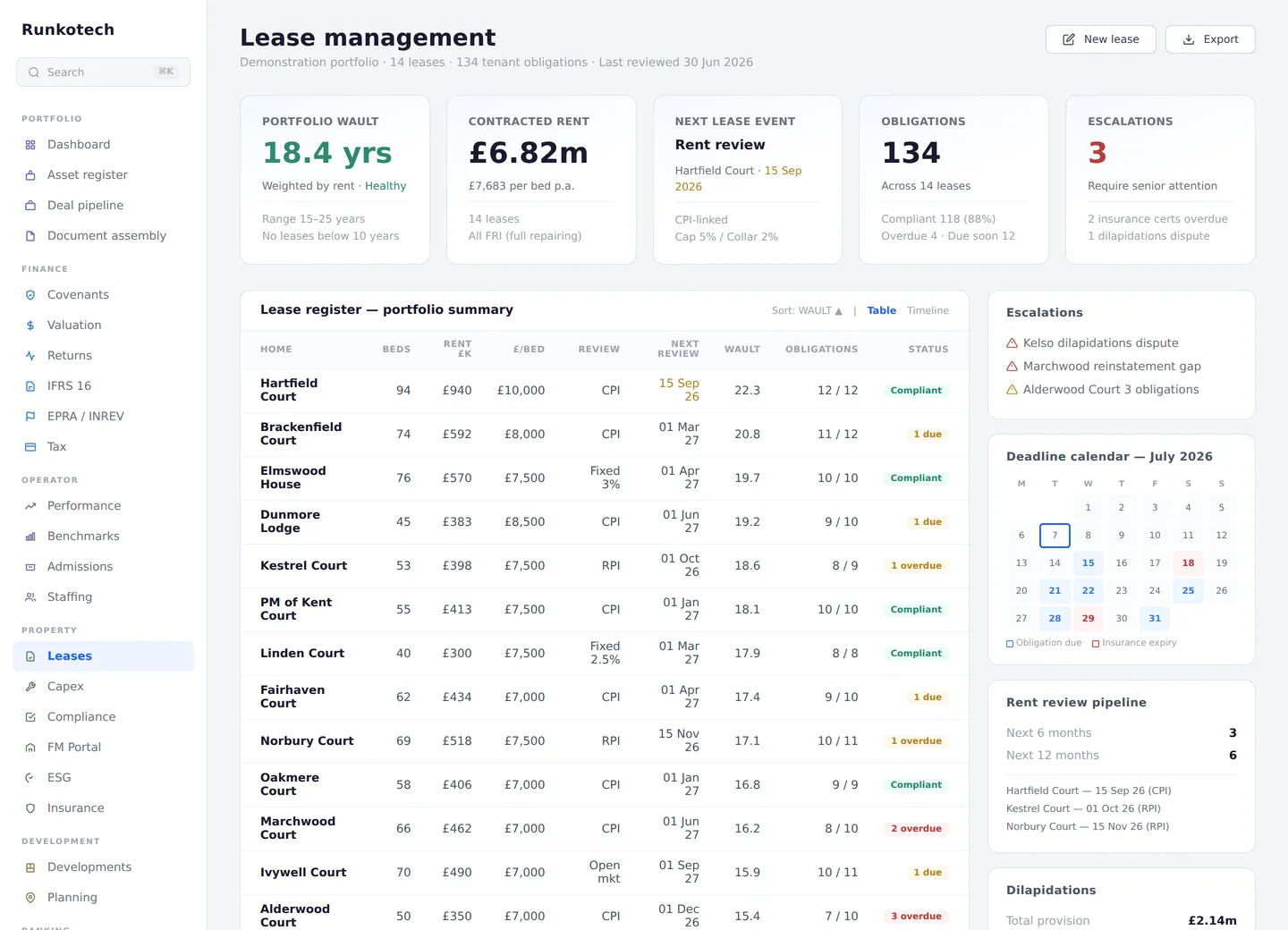
Every lease, its clauses, dates, rent mechanics and obligations, with the documents behind them. Read from the document rather than typed in, so the figure and the page it came from never separate.
Why it goes wrong
A lease is a long document that nobody reads twice.
It was read once, at completion
The lease was negotiated carefully, signed, and filed. Everything it says about reviews, breaks, information covenants, repairing obligations and insurance then sits in a document that is opened again only when something has already gone wrong. The knowledge leaves with whoever did the deal.
The mechanics are not a single number
Rent reviews come on different bases, with caps and collars, at different dates, on different notice. Weighted term is quoted both to expiry and to first break, and the two can be years apart. Rebuilding that by hand before every board is how an error gets in and stays in.
Obligations are owed in both directions
An information covenant obliges a tenant to send accounts, certificates and insurance details on a timetable. In practice nobody tracks what was owed against what arrived, so a late return looks like a quiet quarter rather than a breach, and the first argument about it happens long afterwards.
Dilapidations turn on a distinction nobody recorded
What the lease obliged you to do and what you chose to do are different categories of spend, and the difference is argued at the end of a term from records that were never kept that way. The time to separate them is while the work is happening.
A lease register is not a filing system with search. It is the clauses held as fields, so a question about rent in 2031 is a query rather than an afternoon.
What the module does
Read from the document, with the page still attached.
The register
- Rent, rent per bed or per key, review basis and the next review date
- Term, breaks, options and renewal mechanics
- Weighted term held separately from contractual term, because they answer different questions
- The dilapidations provision taken from the latest assessment rather than a rule of thumb
The clauses
- Repairing, insuring and alienation obligations held as clauses rather than as prose
- Information covenants with what was owed each period and what actually arrived
- Every field tracing back to the page of the document it was read from
What it answers
- What the lease said you would receive, against what arrived
- Which reviews fall in the next eighteen months and on what basis
- Which obligations are met, due and overdue, by property
What it unlocks next
- With insurance on, the clause requiring the cover sits beside the policy providing it
- With operator performance on, the trading figure behind rent cover is produced from the accounts rather than assembled by hand
- With covenants and debt on, the thresholds that figure is tested against come from the clause itself
- With lease accounting on, the IFRS 16 right-of-use asset and lease liability are built from the clauses rather than retyped
Go deeper
A walkthrough, on whichever modules matter to you.
Someone takes you through the modules you actually care about, on the demonstration portfolio, and you ask whatever you like while the screen is in front of you. Usually half an hour, and we come with questions, because we have worked on the operator’s side of these structures.
- Whichever of the thirty-eight modules are of interest to you
- How a change moves through the record, shown live
- What we ask of you to get started, and what it costs
- Security, hosting and the certification timetable