Module · Development and construction
The value of the finished property was fixed before anyone broke ground.
Appraisal, programme, drawdowns, cost to complete, site records and handover. The module exists because of one fact most appraisals do not show on the page: spending more does not make the building worth more, and the debt will not move to meet it.
Why it goes wrong
The margin for error is smaller than almost anyone assumes.
The exit value does not move with the cost
A trading property is worth what it will earn and the yield it sells on. Both are set by the market and the catchment, not by what the build cost. Every pound of overrun therefore comes off the profit at completion, pound for pound, and no amount of specification improvement brings it back.
The debt is sized on the value, not on the cost
Investment debt at exit is a percentage of what the finished asset is worth. It does not rise because the scheme cost more. So the overrun does not share itself between debt and equity in the ratio the appraisal assumed. It lands entirely on equity, and most appraisals hide this by writing the debt line as a percentage of cost.
Spend to date is the wrong number to watch
A scheme running at 60% of budget with 55% of the work done looks fine on a spend report and is already in trouble. The figure that matters is cost to complete, which has to be re-estimated rather than inferred, and which nobody produces monthly unless a system asks for it.
The overrun has to be carried before it becomes equity
Money spent above the budget has to be funded outside the agreed facilities while the property finishes, usually at a higher rate, because the development debt was sized on a value that never moved. The interest on that extra borrowing is a real cost that the day one profit figure does not show, and it has to be carried until it is paid.
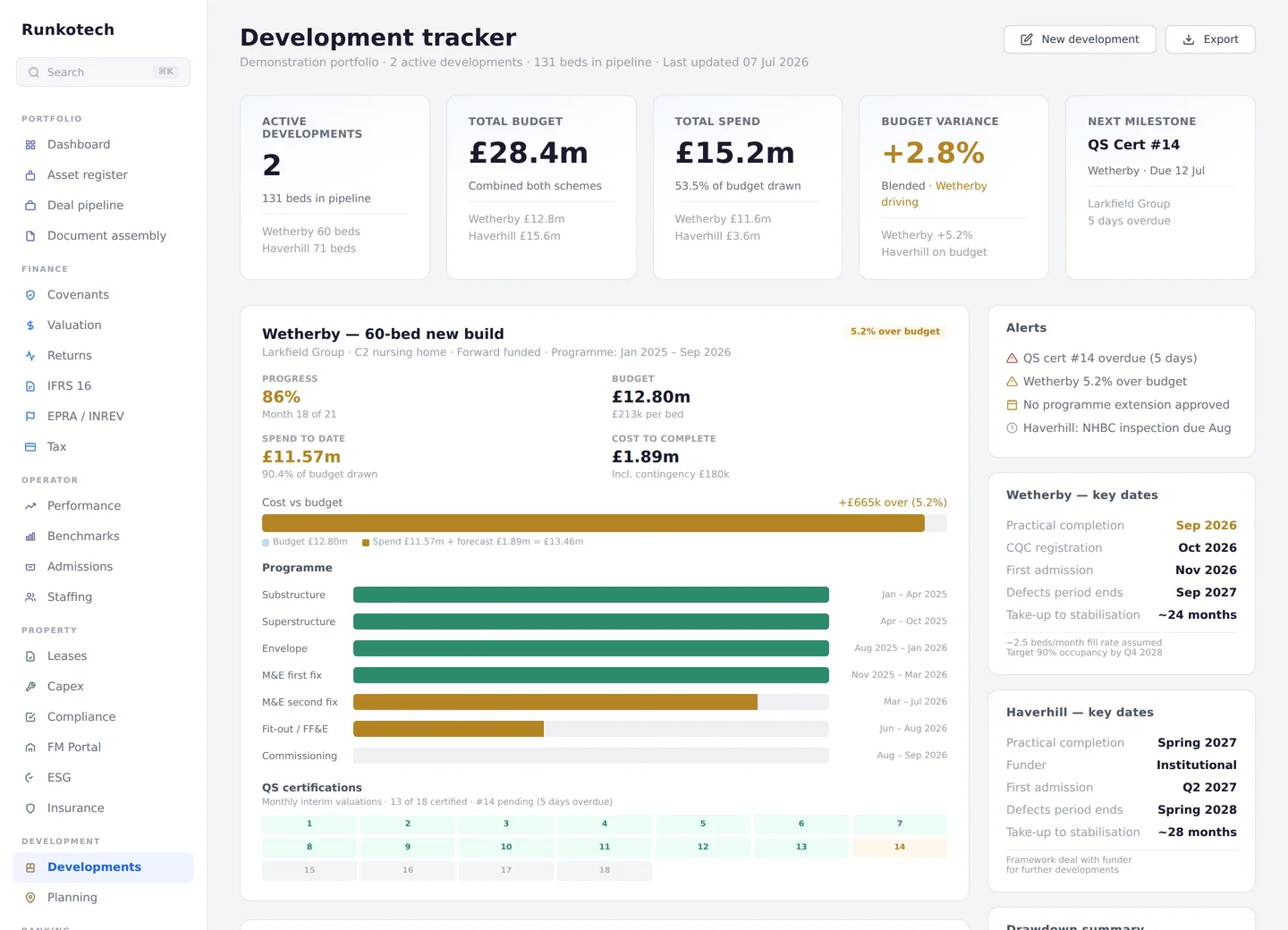
On a scheme of sixty beds with a budget of 12.8 million, the entire margin for error is 1.24 per cent of the budget. A 1.4 per cent overrun turns a profitable scheme into a loss making one.
Try it here
What does an overrun actually cost?
Ashford, the sixty bed scheme in the development pipeline. The assumptions are the appraisal's own. Move the slider and watch which figures refuse to move with it.
What the module does
The appraisal stays live from site acquisition to handover.
The appraisal
- Held as the live model rather than a spreadsheet taken at the investment decision
- Gross development value re-struck as the trading assumptions move, with the yield stated
- Profit on cost and yield on cost shown against the exit yield, so the point at which another pound of spend stops adding a pound of value is visible while you can still do something about it
- Equity required restated whenever cost to complete moves
The programme and the money
- Drawdowns against the facility, with interest during construction carried as a cost rather than a footnote
- Cost to complete re-estimated monthly, beside spend to date rather than behind it
- Variations held with their cause, so an overrun has an explanation attached by the time anyone asks
- Practical completion and the handover record, including the date insurance transfers
The site records
- Defects raised during construction and at handover, carried through to the operational record rather than closed at completion
- Certificates and commissioning documents captured at handover, where they are easiest to get
- Reads from a defects tracker or a construction cost package where you already run one
What it unlocks next
- With certificates on, the commissioning documents become the opening compliance record rather than a box of paper
- With demand and demographics on, the trading assumption behind the exit value is tested against the catchment that has to fill it
- With covenants and debt on, the development facility and the investment facility that replaces it sit in the same place
Go deeper
A walkthrough, on whichever modules matter to you.
Someone takes you through the modules you actually care about, on the demonstration portfolio, and you ask whatever you like while the screen is in front of you. Usually half an hour, and we come with questions, because we have worked on the operator’s side of these structures.
- Whichever of the thirty-eight modules are of interest to you
- How a change moves through the record, shown live
- What we ask of you to get started, and what it costs
- Security, hosting and the certification timetable