Module · Covenants and debt
Your covenants are tested four times a year. Your position moves every week.
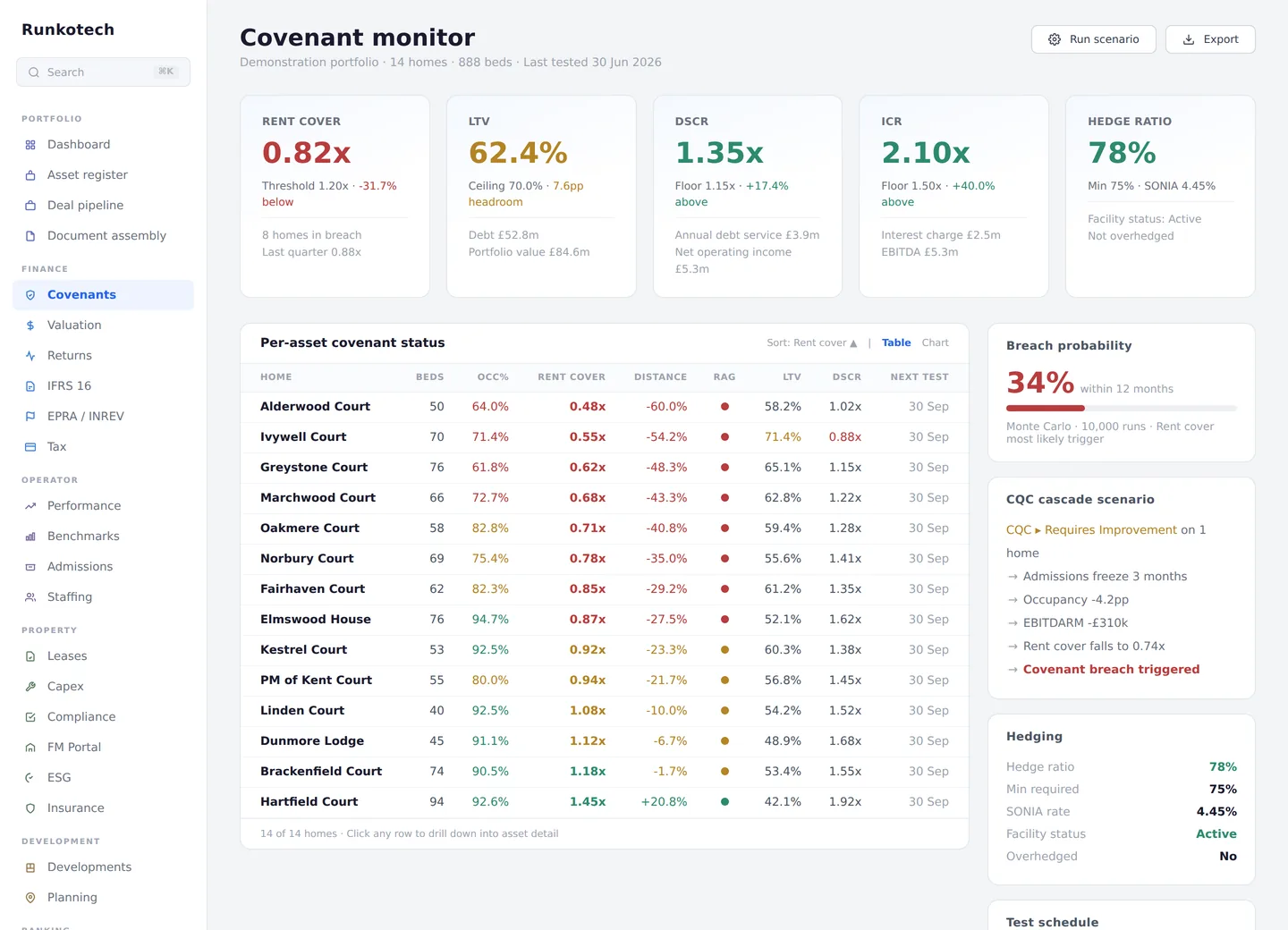
Covenant definitions and headroom, with the facilities, maturities, margins, hedging and drawdowns underneath them. The definitions are the part that catches people out, because the same threshold can be measured against two different earnings figures, and only one of them is the one written into your agreement.
Why it goes wrong
The breach is visible months before the test. Nobody is looking.
Quarterly testing hides a trend
A covenant is tested four times a year on the twelve months behind it. Between tests the position moves every week and nobody restrikes it, so the first time headroom is discussed is the first time it has gone. A vacancy that persists is what breaks a covenant. A bad week never does, and the two look identical in a monthly pack.
The definition is not always the one you assume
Rent cover struck on EBITDARM, and rent cover struck on EBITDAR after a management charge, are two different numbers against the same threshold. One can hold while the other does not. Most groups monitor one of them and find out at the test that their agreement specifies the other, because the lender is the one doing the arithmetic.
Loan to value moves every time occupancy does
The debt does not change between drawdowns, so the ratio moves entirely on the value, and the value of a trading property moves on what it earns. An empty bed is therefore a loan to value event as well as a trading one. Most reporting never makes that connection, because the occupancy figure and the loan figure live in different places and nobody owns both.
Headroom in percentages is not actionable
Being told you are at 1.27 times against a 1.20 threshold tells an operator very little. Being told you are three empty beds from a breach tells them what to do this week. The arithmetic is the same. The unit is not.
Try it here
How many empty beds before a covenant goes?
Hartfield Court is the strongest care home in the demonstration portfolio. Two covenants, measured against two different things, break at two different points.
What the module does
Every threshold read from the agreement, re-struck when trading moves.
The facilities
- Every facility with its lender, margin, maturity and amortisation
- Drawdowns and repayments against the commitment, so availability is a figure rather than a phone call
- Hedging held with the facility it hedges, including the maturity mismatch when there is one
- Which loans mature inside twenty four months, and at what they would reprice
The covenants
- Rent cover, loan to value, debt service cover and interest cover, each against the threshold that actually set it
- The definition held as a field, so a cover ratio states which earnings measure it is struck on
- Re-struck whenever trading moves rather than at the quarter
- Distance to a breach stated in beds, keys or whatever the asset is counted in
What it answers
- Which assets are closest to a breach this week, counted in beds
- What an empty bed does to loan to value, not only to earnings
- Whether a covenant holds on both definitions or only on one
What it unlocks next
- With leases on, the rent and the review mechanics come from the clause rather than from a spreadsheet
- With operator performance on, the earnings figure the covenant is tested on is produced from the accounts rather than assembled by hand
- With desktop valuations on, loan to value re-strikes on the basis the last valuation used
- With insurance on, the lender's minimum sum insured and interested party requirements are checked against the policy that is actually in force
Go deeper
A walkthrough, on whichever modules matter to you.
Someone takes you through the modules you actually care about, on the demonstration portfolio, and you ask whatever you like while the screen is in front of you. Usually half an hour, and we come with questions, because we have worked on the operator’s side of these structures.
- Whichever of the thirty-eight modules are of interest to you
- How a change moves through the record, shown live
- What we ask of you to get started, and what it costs
- Security, hosting and the certification timetable